The Odyssey Is Total Cinema
Christopher Nolan provides pure, concentrated epicness
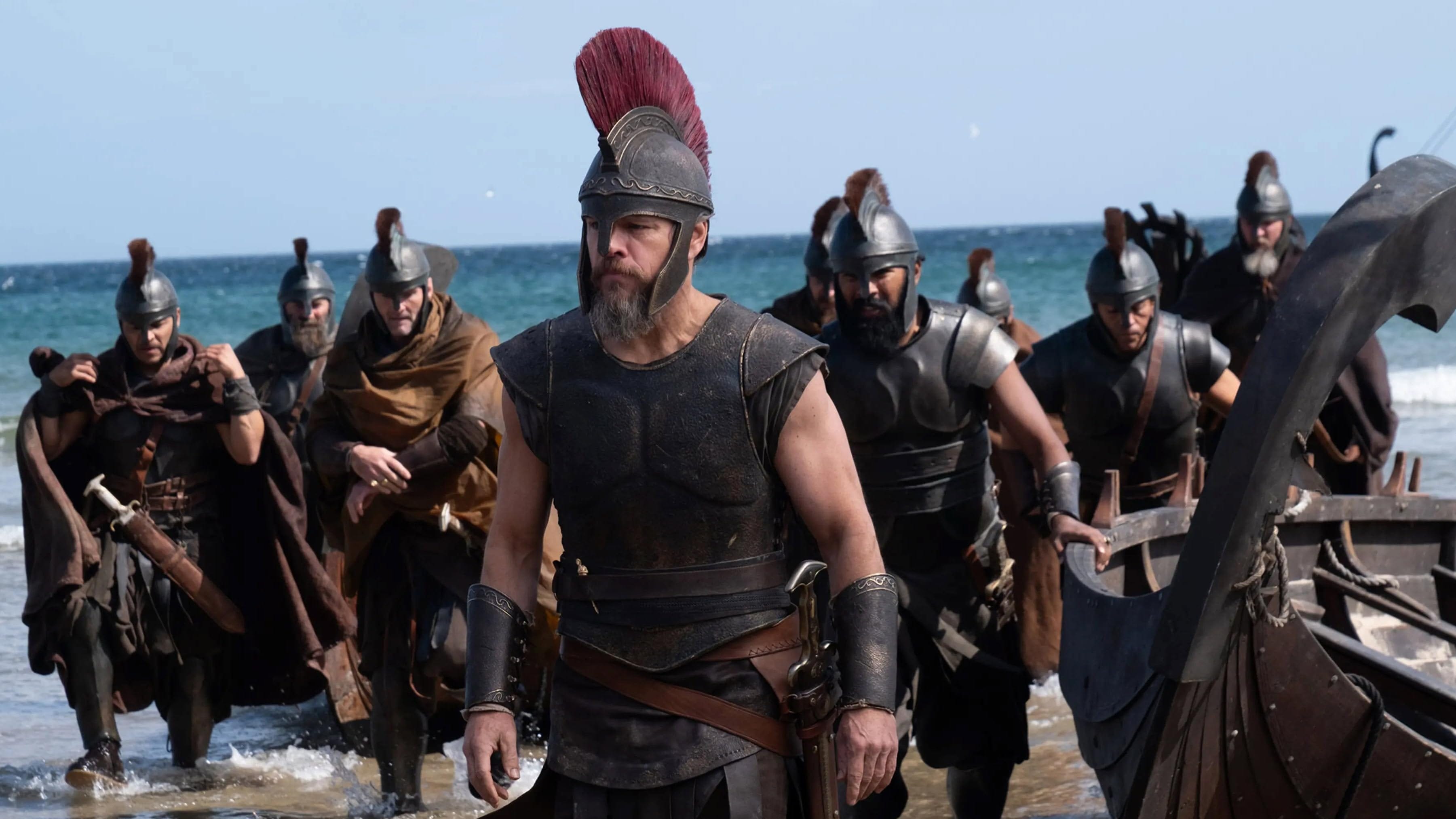
The Odyssey provides a level of jolting excitement reserved for the rarest of recent films like One Battle After Another and Dune: Part Two. That’s how thrilling and visceral the film is. Christopher Nolan crafts sequence after sequence that does what only classical filmmaking does, making the viewer earnestly say, “How did he do this?” I miss that tactility, that question that should burble up, in blockbuster filmmaking—and Nolan is arguably the last man still supplying it, that realism a resolute and necessary truth.
Matt Damon is solid and sturdy in the role, with a little twinkle of the classic Odysseus duality: the cleverness that gets him out of binds and the pride that gets him into more. Anne Hathaway is fantastic as Penelope — a vintage role for her, giving the “when will my husband come home from war” wife more color, personality, and embodiment than the stereotype usually gets. Tom Holland delivers probably my favorite performance of his ever: a greenhorn, but with a determination that lets you see the linkage between him and Damon‘s Odysseus. And Robert Pattinson is a venal, sniveling delight as the lead suitor—truly a highlight.
I was less impressed by Zendaya, who doesn’t add much as Athena — a shame, because that’s such a brilliant, bewitching goddess — and by Charlize Theron, who is out of place and way too shiny as Calypso. It doesn’t help that her scenes are solely exposition dumps, opportunities for Odysseus to regale the audience with past exploits.
Samantha Morton steals the show as Circe. She’s the best-trained capital-A actor of anyone here, and she imbues her section with intensity and intelligence in equal measure. With a genuinely witchy presence, she’s crucially one of the few characters who becomes a mental hurdle for Odysseus rather than just a physical obstacle. The Circe sequence might be the best, most fascinating filmmaking Nolan has ever done—a mini folk horror tale that references the text, obviously, but perhaps even Miyazaki‘s Spirited Away. That blend of horror, magic, and precise filmmaking is The Odyssey at its best.
Akin to Oppenheimer, this is Nolan observing and dissecting a great man responsible for a devastating amount of violence and death — a figure wracked by guilt and shame. Even though he’s ostensibly the hero of his own story, he doesn’t feel like it. And Nolan, always tricky with temporality, weaves and intersects his timelines toward a bravura, devastating sequence near the end.
We’ve seen the sack of Troy up to a point—the preparations for the horse, the horse pulled into the city, and the successful attack—but the film goes a step past triumph and into consequence. If anyone watches this and thinks Odysseus is a pure white knight hero, they’ve missed the point. Yes, he’s resilient and wily. But he’s also a war veteran with years of PTSD to shake off before he can feel worthy of returning home, worthy of Penelope. The lotus flower served up by Calypso doubles as a coping mechanism drug to numb the pain he’s caused, the men he’s lost, and the decisions that have hurt others, even amid so much heroism.
You’ll hear a lot in the film about Zeus’s law: treat others the way you want to be treated and always welcome the stranger. It’s a little heavy-handed until the ending drives it home. We all know the story of the Trojan horse, but Nolan makes us reckon with the darker meaning of it as a deception of people and how that’s doubly devastating. Forget that everyone is killed and pillaged because of it—it’s the tricking that weighs most on Odysseus, his cleverness utilized for bloodshed. Damon has to wear that pain and live it, and he wears it well. I wouldn’t say the film is as subversive and brilliant (nor as magical) as Circe by Madeline Miller—still the ultimate in revisionist fiction and a crucial feminist text—but Nolan has grave sensitivity about Odysseus, and he isn’t afraid to paint him realistically.
If you’re a Greek mythology lover, you’ve got everything you want here. Beyond the central story, Menelaus and Agamemnon are played pretty amazingly by Jon Bernthal and Benny Safdie. They don’t disappear into their roles so much as provide an audience touchpoint for these brilliant kings of Greece—they make them men, their pain realer, their foibles relatable. No matter how cool their armor is, these are just guys.
If there’s a real flaw, it’s imbalance—and it’s born of the film’s own excellence. The Cyclops sequence, Circe—these stretches are so revelatory and spectacular. They’re the purest definition of awesome, and it means other, less involved travails get shunted. The sirens and Calypso, for example, widely miss the mark.
They’re not bad sequences; for any other filmmaker they’d be considered strong. It’s just that when Nolan is this fantastic at his craft, the moments where he doesn’t pour everything in sit in starker relief, fair or unfair. It’s kind of bananas to say, but I wish the budget were even larger and the movie even longer (I understand technological aspects of all-out IMAX filmmaking hinder this). You’re so engrossed in this world that you just want more. Adding more in the middle of the film – the meat of the titular journey – would’ve improved a tremendous film even more.
Nolan‘s slight wonkiness with female characters like Calypso and Athena rears its ugly head. The one place he disproves this is the Circe section, which—besides the ending—is the only moment where someone gets to tell Odysseus what’s what. Morton‘s Circe goes in on him in a way I needed more of. It’s one of the film’s thornier exchanges on gender and violence, and while too much ruminating would’ve slowed things down, a little more would have been beneficial.
And, don’t get it twisted that I necessarily needed this, but the film has an opportunity for eroticism and ends up pretty sexless. My theory: Nolan got laughed at for the sex scenes in Oppenheimer — which, to be fair, are a little clunky — and decided to avoid it altogether.
Narratively, I get it. There is sex and sexuality in Homer’s Odyssey, with Circe, with Calypso, and even with Penelope, but if Odysseus were to be an adulterer in the film, it would ruin the beauty and sanctity of the homecoming. You can’t cheat on Anne Hathaway! That’s a necessary tweak, yet the sirens could’ve at least served that role. A tiny bit of Paul Verhoeven could’ve gone a long way. The film earns its R rating with brutality; how about a little eros?
But these are minor gripes about a film that is truly awe-inspiring — total cinema on display. There’s a brutality and a sentimentality to this one, moments of heart and tenderness (including some of the sweetest, most gorgeous dog moments you’ll see all year) that we never would have gotten from the hard-edged guy who made Memento nearly 25 years ago.
On the spectrum of depth versus excitement, The Odyssey tips toward the latter, while Oppenheimer represents the former. The Odyssey will be the more beloved film. I certainly enjoyed watching it more than Oppenheimer, even if Oppenheimer gives you more to chew on and still might be the better movie. To even wonder this just proves that Christopher Nolan, always going for it, bigger and better, is a one of one. With The Odyssey he serves up pure, concentrated epicness.


