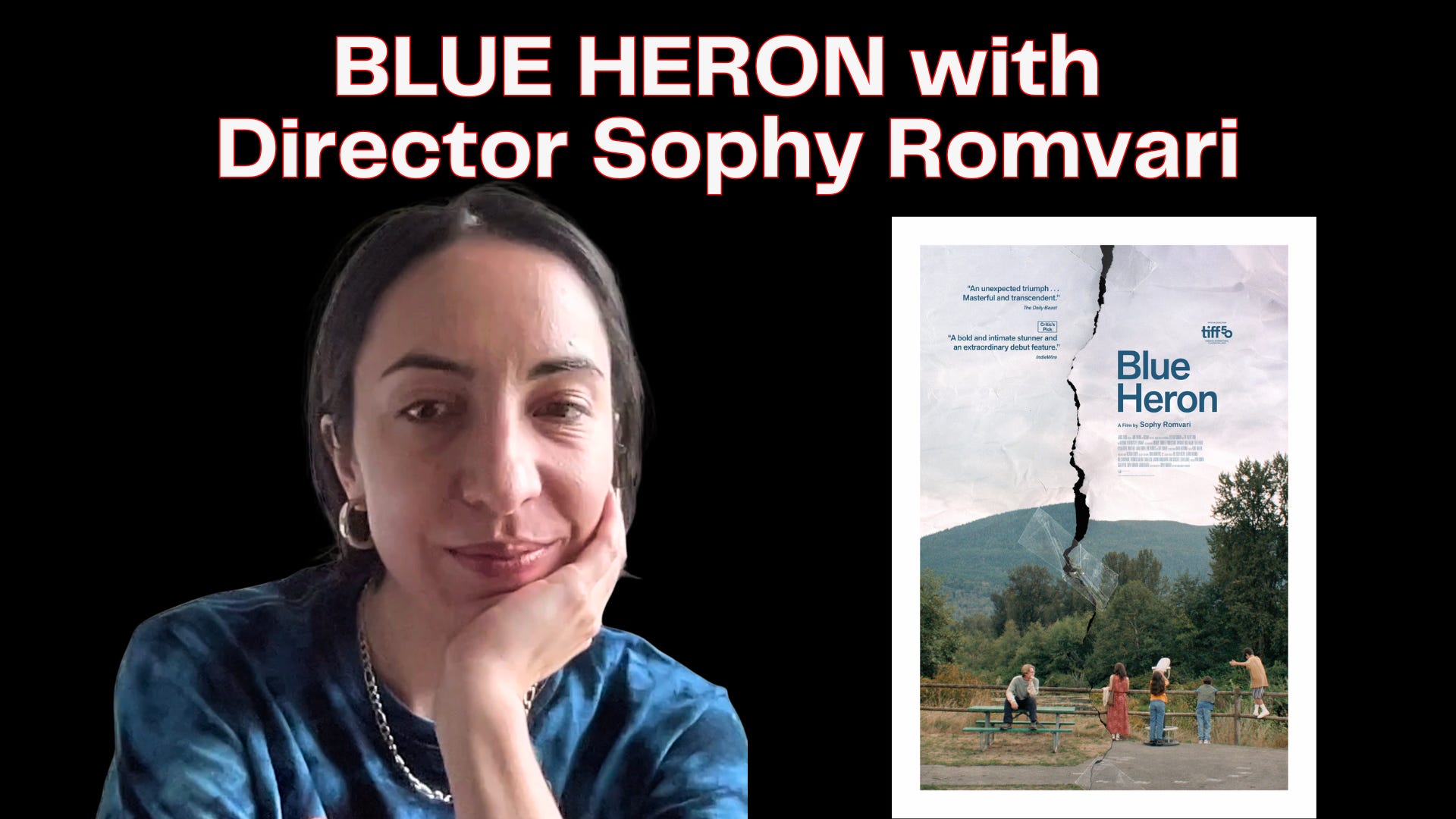
Sophy Romvari on BLUE HERON, Time Travel as Editing, and the Power of the Zoom
The Canadian writer-director on Altman, the journal she kept on set, and the Minnelli musical lurking in her future.
Sophy Romvari’s Blue Heron is a quiet stunner — a personal, time-bending feature that blends fact and fiction, past and present, and arrives as part of a remarkable wave of personal Canadian cinema. I spoke with Sophy from CinemaCon at Las Vegas (couldn’t be a more different place) to talk craft, comfort films, and what she wants to make next.
Schmear: We always start with the same question — what’s a no-notes perfect movie to you?
Sophy Romvari: Robert Altman’s Short Cuts. I watched it a lot during prep for this film with my cinematographer, Maya Bankovic. I think it’s just such a perfect use of adaptation — the way it adapts the short stories into a cohesive feature narrative, but you can also see all the parts being stitched together through the way he uses the camera, the zoom lens. Performances top tier. Production design unbelievable. Sound design off the chains. No notes.
Speaking of Altman, I want to ask about the power and purpose of a zoom shot — kind of an underrated shot, if there is such a thing. Why do you utilize it so much in Blue Heron?
I agree, it’s become underutilized. The association with it became a little bit corny over the last couple of decades. But it’s such an effective tool for creating a dynamic shot without actually moving the camera. We didn’t want to use a dolly, because as soon as you use a dolly on set you’re basically cutting your day in half. With the zoom you have so much freedom to create momentum that feels raw and alive. We shot everything on a tripod, but we had this beautiful long zoom lens.
You can get into someone’s psychological state without moving the camera, which is great for performance — you’re not invading the actor’s space. You can be far away and still have that intimacy. For any filmmaker who uses a zoom lens, it becomes quite addicting. We weren’t planning to use it as much as we did, but we kept having moments of inspiration where it felt like — might as well zoom again.
I understand you journaled every night of production. What were you reflecting on?
I’m a little bit obsessed with reflection, as you might have noticed — reflecting on the past, trying to learn from past patterns, see how I’m changing or evolving, or in many cases, not. Journaling during production was motivated by not wanting to forget the experience, not wanting to forget the feeling I was having, which was quite euphoric, to be honest.
The journal entries are very basic. They’re like, I’m happy, this was a great day, I love making movies. Just very straightforward. I wanted to remember the feeling, because you can retroactively adapt a memory into being stressful, but then all the nuance gets lost of what you were actually feeling. Every day it refreshed the feeling of being grounded, and the gratitude for what I was getting to do.
Jeremy is such an enigma in the movie, and Edik Beddoes is wonderful. You’re on edge constantly with his behavior — and then there’s that beautiful, rich map-making. What do you think that’s an expression of?
The character is very much inspired by my own brother, but the process of making this film made me reckon with the fact that there was never going to be a version of this movie where it actually is a real depiction of my brother. I wanted to integrate elements of the person I knew, but I also didn’t want to try too hard to get it right, because I know I would have failed. My brother was a very different kind of enigma.
The maps you see in the film were his actual original maps. I always thought they were so fascinating, especially because they’re completely fictional. They happened to really align with the themes of the film. When my parents gave me permission to include them, I was so happy — it’s a kind of retroactive collaboration, because I do think of them as artwork. We were able to incorporate elements of the maps into the title design, because I wanted everything to feel handmade. The fiction and the reality start to blend in ways that I even start to question — where does it start, where does it end?
It’s so striking because some of the actions are harmful or violent or strange, and then the map is beautiful. You wonder, “Where in the brain did that come from?” It sets your mind racing about what people who are struggling are actually capable of, if things broke differently.
Yes — just like the internal world of someone you can’t understand. It felt like a really beautiful and efficient way to give a glimpse into this person’s state of mind and complicate the character. There is a version of this movie that villainizes him. Films often do that with teenagers. It was important to me that the character did feel actually quite threatening, but also had complexity, was also kind, was also seen from different perspectives. It’s not until the end of the film that you hear that perspective from a friend, someone outside of the psychological apparatus. That’s actually something that did happen to me — I received that version of that email while I was writing the script. I was pretty blown away by the timing, but also it really humanized my brother in a way I struggled to do when I was young, when there was just frustration or anger toward this person.
What was the first movie you remember seeing in a theater that had a big impact on you?
I’ve been thinking about this a lot lately because it feels so thematically linked, but I’m pretty sure the first movie I saw was Spielberg’s A.I. It’s the first one I have a memory of sitting in the theater for. I was with my mom.
That’s a heavy one.
Very heavy themes. I just rewatched it two months ago and pretty much cried the whole time. So devastating.
When was it — 2001?
2001 — I was 11. I didn’t see a movie before that because I was living on a very small island that didn’t have a theater. I remember it because of that experience, and because the movie was so profoundly magical. You get so swept up in that world. It’s also about a young kid about my age at the time. I knew that I was experiencing something beyond my reach — I knew emotionally I wasn’t picking up on all the nuance. I did find it very magical.
So my favorite critic, Richard Brody, loved your movie. He likened it to Nickel Boys and The Secret Agent and how it plays with fact, fiction, and memory. How do those comps sit for you?
The Brody review really did hit different. I woke up first thing in the morning, read it with one eye open, and it was just so... yeah. As we all know, it could go many ways. His opinions are very much his own. I knew there were other films in the wheelhouse of this film that he liked, so I was hopeful, but I also wasn’t sure. I’m just very honored. The writing is beautiful.
I actually haven’t seen Secret Agent. I know every filmmaker says this when promoting a movie, but I’ve seen fewer films this year than any other year of my life. A few people have told me there are similarities, which is always interesting because these things start to become a bit zeitgeist. While I was writing this movie, Céline Sciamma’s Petite Maman came out, which has a similar kind of time-blending in a childhood home. Then Aftersun came out, also very much in alignment with a character looking back at their past. As I was watching Aftersun, I was thinking about how many ways there are to tell a story from that perspective. It was inspiring to see how people responded — it made me feel like there’s space for these kinds of movies and people are interested in them.
There’s also All of Us Strangers — the character goes back to his childhood home and his parents recognize him. Watching it, I remember thinking the version I wanted to explore doesn’t have that recognition. Nickel Boys — I don’t know that I fully see the similarity, except maybe the end of the movie when it shows the character. That research at the end was really incredible. It’s such a formally driven movie. But it’s a very cool comparison.
You have such an amazing time jump in Blue Heron — I won’t spoil it. I’d love to talk about time jumps in other movies. What do you think of the one in A.I.?
It’s devastating. That shot of the little submarine — is it a helicopter that turns into a submarine? I can’t remember. Just him sitting there watching as millennia go by, it’s the most devastating thing. His fortitude to wait for this to occur, and then he finally has that moment — he gets to go back into his childhood home and have one last day with his mom. I’m shivering just talking about it. The moment when Teddy takes out the hair he cut from her — it really fucks me up.
It’s just hitting on every human emotion you could possibly want to explore in a film. It’s outstanding.
How about 2001: A Space Odyssey, with the bone in the air?
Incredible. The funny thing is, time jumps and time travel are so perfectly utilized in film because as soon as you edit, you’re traveling through time in some way. Sometimes it’s minuscule, just a jump cut, and sometimes you can jump 100 years, five years, whatever you want.
When I realized — I mean, everyone knows this about editing, but when I realized I didn’t have to show a character traveling through time, I could just have her arrive in a timeline without explaining it and bring the audience along, it made me feel excited by that opportunity. You have to trust the audience is going to pick up and follow what you’re putting down.
We tried really hard, near the beginning of the film when the social worker arrives — it’s basically shot for shot a remake of that beginning. We recreate it with Sasha when she comes back as a version of the social worker. Same shots of her entering the home, same sound design, same point at which the TV show is playing. Everything is the same. Then when her dad comes out and doesn’t recognize her, that’s part of allowing the audience to know — okay, you’re in some sort of a strange middle ground of reality.
This movie is dealing with some heavy themes. What’s a comfort film you return to when you need a little inspiration or happiness?
I don’t know if I’d call it inspiration, but I have long since been beating the drum that one of my favorite movies is There’s Something About Mary. So many of my favorite films are kinds of films I would never want to make or be able to make. There are so few great comedies made in contemporary cinema. It’s rare that I really truly laugh in a movie. When a comedy is pulled off, or when a horror movie is pulled off — that’s the ultimate. There are few that really pull off those genres, which is why so much of the box office is driven by genre. So rarely do they actually work. But we’re going to keep trying until we get there.
It feels like Canadian cinema is having a moment — Blue Heron, Matt Rankin’s Universal Language last year, Mile End Kicks, Nirvanna the Band the Show the Movie. How would you explain this phenomenon, if there is one?
It shouldn’t be a phenomenon, because it’s a giant country with public funding. It’s interesting talking to people from other countries, especially the U.S., about what films actually get on the radar outside of Canada, what films function outside the Canadian landscape. It’s surprising how rare it is. There are only a few filmmakers who are really globally known from Canada, and for such a big country, that’s been the case. Obviously everyone knows Cronenberg, or Atom Egoyan and Sarah Polley if you’re paying attention.
All the filmmakers you mentioned — we’re all in communication with each other, very supportive of each other. There’s a real camaraderie of wanting to see each one succeed, because any success that comes out of Canada should be uplifting to other Canadian filmmakers. It creates a pathway to being recognized within a global landscape.
Even the movies I just mentioned are all so different.
All of them are distinctly personal films. All of them deal with some sort of autobiographical elements. Within the Canadian history of cinema, there are a lot of personal films, a lot of films made with limited means. That ends up often being personal and integrating elements of nostalgia. It’s funny that both my and Matt’s films are time travel movies, but in very different ways.
After making something this personal, do you feel like you’ve exorcised something — and if so, do you feel freer in regard to what you make next?
I genuinely do. This film was so cumulative — not just of my life experiences, but of all the work I’ve been making. All of my short films now feel like experiments that worked toward this film. When I look back at the shorts, I can see I was trying different things that ultimately did contribute to how this film functions. They’re all to varying degrees attempting that, but this film feels like it succeeds. It feels like I’ve accomplished what I was trying to accomplish with my entire career, basically. Which is exciting but also daunting, because now that I’ve done that — okay, well, what next?
There’s a relief in it. I feel like I accomplished something I set out to do, and now I do have the freedom to move into whatever direction I want. I know the modes of filmmaking I’m interested in, and I know I want to enjoy the process of making every movie I make. Those are the things I’m prioritizing.
What’s something people might not peg you for, but you’d love to make?
I don’t have a story or context attached to this, but I’m a huge Vincente Minnelli head. I love classical Hollywood musicals. Maybe not apparent in my work, but the total work of art that comes with those films is a lost form. It would be very difficult to pull off in contemporary film — no offense to La La Land — it really takes such a huge studio apparatus.
I have thought about ways to subvert it, or have a musical be a part of a film without the film itself being a musical. Because you really get to work with as many possible art forms — dance, music, color, light, camera. It really is everything.
I also don’t want to just always make sad movies. I feel like I’ve made so many sad movies.
Last question — what do you want people to take away from Blue Heron?
I don’t have a specific want, so much as I’ve been really moved to see how open people have been to receiving the film. What I’m taking away from it is a gratitude — making this work has been very beneficial to my process as a human being, of processing my past and being able to move forward.
My hope is that people don’t shy away from doing that in their own lives. You don’t have to make a feature film to do it. From what I understand, this film has provoked conversations within families, between siblings. People have told me they’ve reached out to a sibling they were no longer speaking to. The fact that people are open to those feelings is really moving to me.
Blue Heron is in theaters now.