Schmear's Best Movies of 2025: #10-1
The crème de la crème
We’re back with my top 10 of the year. If you missed 20-11, check them out here.
Let’s get right to it. No spoilers here:
#10 — The Testament of Ann Lee
The Testament of Ann Lee is an utterly ecstatic experience, anchored by one of my favorite performances of the year from Amanda Seyfried. The film comes from Mona Fastvold and shares a lot of DNA with The Brutalist, but it feels feminist in a way that’s genuinely earned. The Shaker movement famously eschewed sex, but in its place was something intensely euphoric and expressive—dance, movement, and singing—and over the course of the film, Mona Fastvold fully brings you into that world. The period details are immaculate, and the songs, adapted from real Shaker folk tunes, are exquisite and intoxicating. The movie puts you under a spell, to the point where it makes you want to be a Shaker yourself. Leading the way is Amanda Seyfried, who has always been a highly respected performer, but here is stretched to her dramatic limits and clears the bar with ease. I’ve only seen it once, but I can’t wait to watch it again—the songs and choreography stayed in my head for a long time afterward.
#9 — The Phoenician Scheme
The Phoenician Scheme was way too easily tossed off as just another Wes Anderson curio, but it features Benicio del Toro in what is arguably an even better performance than his work in One Battle After Another. The film plays as a touching, fun father-daughter adventure romp—like Wes Anderson’s version of Tintin or Raiders of the Lost Ark. It’s a pleasurable, globe-trotting movie with sly political undercurrents tied to its Cold War setting. I think it works for younger audiences, but it also lands as soulful and meaningful for adults. Like Wes Anderson’s underrated Roald Dahl adaptations, the film’s fable-like quality isn’t a bug; it’s the feature—it’s meant to wrap up neatly and leave you with a moral. The sumptuous colors and production design are incredible, even if that’s now treated as standard for Wes Anderson. Also: how is this the first time Michael Cera has worked with him, and can we please make sure it’s not the last?
#8 — Sinners
What can be said about Sinners that hasn’t already been said? It’s multiple movies in one, but in a way that feels genuinely fresh. Ryan Coogler is clearly having a ball, but he’s also making a serious statement about race, artistic integrity, and the vampirism of culture. He wears his influences on his sleeve, and in doing so creates something that still feels wholly original. Michael B. Jordan takes on two roles and acquits himself beautifully, giving real differentiation and life to both Smoke and Stack, while Delroy Lindo, Jack O’Connell, and Hailee Steinfeld all deliver memorable supporting performances. I don’t think any film celebrated music more winningly this year. Entirely divorced from IP or adaptation, Ryan Coogler cemented a near-instant rewatchable—which is no small feat.
#7 — It Was Just an Accident
It’s absurd to rank It Was Just an Accident at number seven, given how close it is to flawless as a political statement, as a darkly funny Coen Brothers–esque farce, and as a dissection of modern-day Iran. The film captures the country at its best—the interpersonal generosity—and worst: the ever-present terror of looming authoritarianism. Jafar Panahi constantly forces you to question the moral ground of its protagonists. This is done with an incredible amount of humor and precision, including multiple gags about corruption that feel unmistakably pulled from real life. Many of the performers are first-time actors, and their anonymity gives the film a rare immediacy. Though tailored to Iran, its themes—evoking Samuel Beckett’s Waiting for Godot—feel mythic and transferable to any moment in history where absolute power threatens society. The film’s ambiguous, frightening ending is the disturbing cherry on top of an impeccable picture.
#6 — Marty Supreme
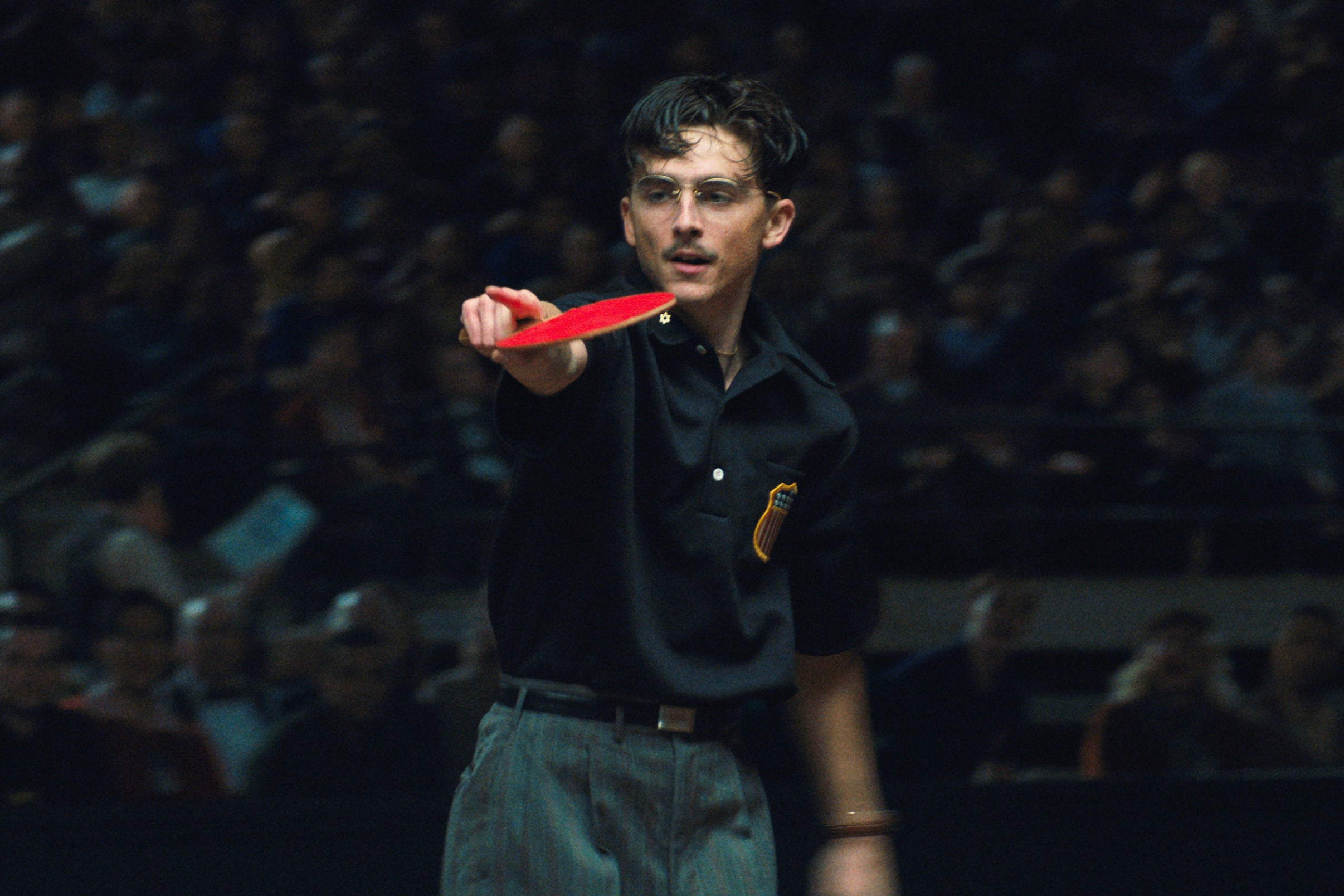
I went long on Marty Supreme a few days ago, but it belongs here. Josh Safdie and Timothée Chalamet have diagnosed past, present, and future American delusional exceptionalism with real vigor and relentlessness. Timothée Chalamet is fidgety and forceful, with that twinkle in his eye and magnetic quality that makes him believable both as someone chasing greatness and as someone who tramples over everything in his one-track pursuit of it. He’s buoyed by a really strong and distinctive supporting cast, especially Kevin O’Leary, who steps into the role of a powerful capitalist with a shit-eating grin a little too easily. I can’t wait to rewatch this immediately and bask in all of its ugliness, stress, success, and glory. Josh Safdie holds all of these contradictions at once, painting a surprisingly accurate portrait of the American ideal while evoking both the manic pleasures of Boogie Nights and the diasporic quest for belonging explored in The Brutalist. It’s a movie set in the ’50s that feels completely contemporary.
#5 — No Other Choice
I needed two viewings of Park Chan-wook’s No Other Choice to fully appreciate just how detailed, layered, and brilliant it is. That’s on me. We all know Park Chan-wook is the king of the camera. His setups, movements, and edits are bewildering and awe-inspiring, but they’re secondary to a truly great story adapted from Donald Westlake’s The Axe. The film follows a man fired from his mid-level job at a paper company who decides to eliminate his competition—literally—in pursuit of new work. It’s a bleak assessment of late-stage capitalism that feels uniquely Korean, yet deeply resonant across other high-income societies. Lee Byung-hun is spectacular as Yoo Man-su, a man desperate to maintain upper-middle-class trappings like tennis lessons and cello tutors and slowly driven mad by that pressure. The line blurs between his need for employment and the thrill he takes (and manhood he regains) in the pursuit. The film’s characters are clawing over one another for the last spot on a sinking ship. Once the story is in motion, time flies, driven by dark humor, playfulness, and a strong sense of moral—or perhaps hypocritical—indignation. The ending—like so many in this year’s great films—is a Pyrrhic victory.
#4 — Eddington
Eddington is another film about late-stage capitalism, but more specifically a fiercely political portrait of 2020—its confusion, stupidity, and lasting damage. Ari Aster treats that year as patient zero for our current condition, capturing what has since metastasized. Usually period pieces need distance to clarify their meaning, but Ari Aster’s rapid assessment feels pinpoint accurate and unsparing in its nastiness. Joaquin Phoenix’s Sheriff Joe Cross starts as a decent enough man who spirals due to wounded ego, political expediency, and the omnipresence of smartphones and social media. Some people dismissed the film as annoyingly apolitical, and many I spoke to out of Cannes outright hated it, but I connected to it immediately for its dark humor and withering assessment not just of politics but of activism itself. Nearly everyone in Eddington is motivated by self-preservation and self-interest. Characters’ pursuit of “justice” is more often driven by sex, money, or ego than any deeply rooted moral framework. I understand why that turns people off—especially when society needs a spine more than ever—but if we can’t understand our recent history, we’re doomed to repeat it. Eddington identifies the breakdown of community, the isolation, and the algorithmic polarization that defines our present, and it does so in a film that’s also thrilling, funny, and sharply made. That combination is what makes it feel so bracing.
#3 — The Secret Agent
Set in 1977 Brazil, Kleber Mendonça Filho’s The Secret Agent is packed with themes—family, power, culture, and diversity—yet renders them with the most nuanced and colorful of brushes. This is a wildly cinematic, stunningly beautiful, very weird, and deeply moving thriller with real soul. Its evocative title is something of a red herring; this is a far more complex and heartfelt film than a standard espionage tale, though there are thrills to be had. Wagner Moura gives perhaps my favorite performance of the year as Marcelo, the antithesis of a debonair James Bond type. He’s a scruffy academic thrust into circumstances far larger than himself, which makes him instantly relatable and easy to root for. Kleber Mendonça Filho cited Cary Grant in North by Northwest as a point of reference, and Wagner Moura carries a similarly classical star power that commands every frame he’s in. The film is filled with diversions that don’t detract from the experience but instead are the experience, revealing a Brazil composed of countless cultures and lives—from Tânia Maria as Dona Sebastiana, caring for her island of misfit toys, to Udo Kier’s strange and moving final performance as a Holocaust survivor. Every face is memorable and etched in the mind. Like memory itself, you may not retain every plot detail, but the rhythms and feelings linger powerfully, which is fitting, since memory is such a crucial hinge point of the film. What could have felt like a history lesson is instead brought vividly to life.
Wagner Moura Red Carpet Interview
No Notes Podcast - Kleber Mendonça Filho
#2 — Sentimental Value
I’ve found myself defending Sentimental Value frequently over the past few weeks, and I’m more than happy to do so. Joachim Trier’s latest is a moving, mature, funny, and deeply poignant family drama, full of humor and genuine pathos. It feels like a movie made for adults—one that understands modern life contains pain and pleasure, trauma and humor, often at the same time. Joachim Trier has crafted something so hyper-specific that it becomes universal, allowing viewers to graft their own emotions and familial dynamics onto the story. Every performance is sharp, from Renate Reinsve, who makes the lead role look effortless, to newcomer Inga Ibsdotter Lilleaas, with whom she shares a wildly realistic portrait of sisterhood. Stellan Skarsgård and Elle Fanning riff on their own personas and their place in the film industry in a way that’s meta, funny, and surprisingly honest. The needle drops are immediate and soul-stirring—I find myself putting the soundtrack on and feeling it all rush back. The film is poetic without being ostentatious, epic while remaining intimate, and a series of beautiful juxtapositions that carry tremendous meaning. The way the past reverberates through the present—embodied by the house at the center of the story and by the characters themselves—is profoundly moving.
Red Carpet with Joachim Trier and Eskil Voght
Red Carpet with Stellan Skarsgård
Red Carpet with Renate Reinsve and Inga Ibsdotter Lilleaas
#1 — One Battle After Another
Probably the most written-about, talked-about, and memed movie of the year—and with good reason—Paul Thomas Anderson’s One Battle After Another feels like an epic in the fullest sense, an instant modern classic packed with iconic characters, quotable lines, incredible music, and the uncanny sensation that this brand-new film has somehow been with us our entire lives. No one internalizes and reshapes the logic, language, dreams, and fears of cinema quite like Paul Thomas Anderson, and this is his most distilled and entertaining work. Is it his best? I’ll let others decide, but it’s his most movie movie. The sheer audacity of opening with a raid on a detention center left me stunned. I’ve seen it three times now, and each viewing unlocked something different. The first time, I was a bit suspicious, wishing for something more symbolically dense like The Master or There Will Be Blood. The second time, I was soaring, just fully riding the (ocean) waves. By the third, I saw the larger picture and thought about it in relation to The Big Lebowski—and how few films reach that rare, totemic plane of entertainment and existence. Leonardo DiCaprio’s performance is shockingly humble and gleefully dumb. Every actor here brings their A-game as PTA pulls something singular out of each of them. Whether you come for the political urgency, the mythic scope, or the stoner-comedy pleasures, there are countless ways in and out of this movie.
See you in 2026 — time to lock in on Industry and The Pitt ;)


Great list Gabriel! The only one of these films I haven't seen in Eddington. Based on how it is appearing on other people's lists it looks like I need to check it out!