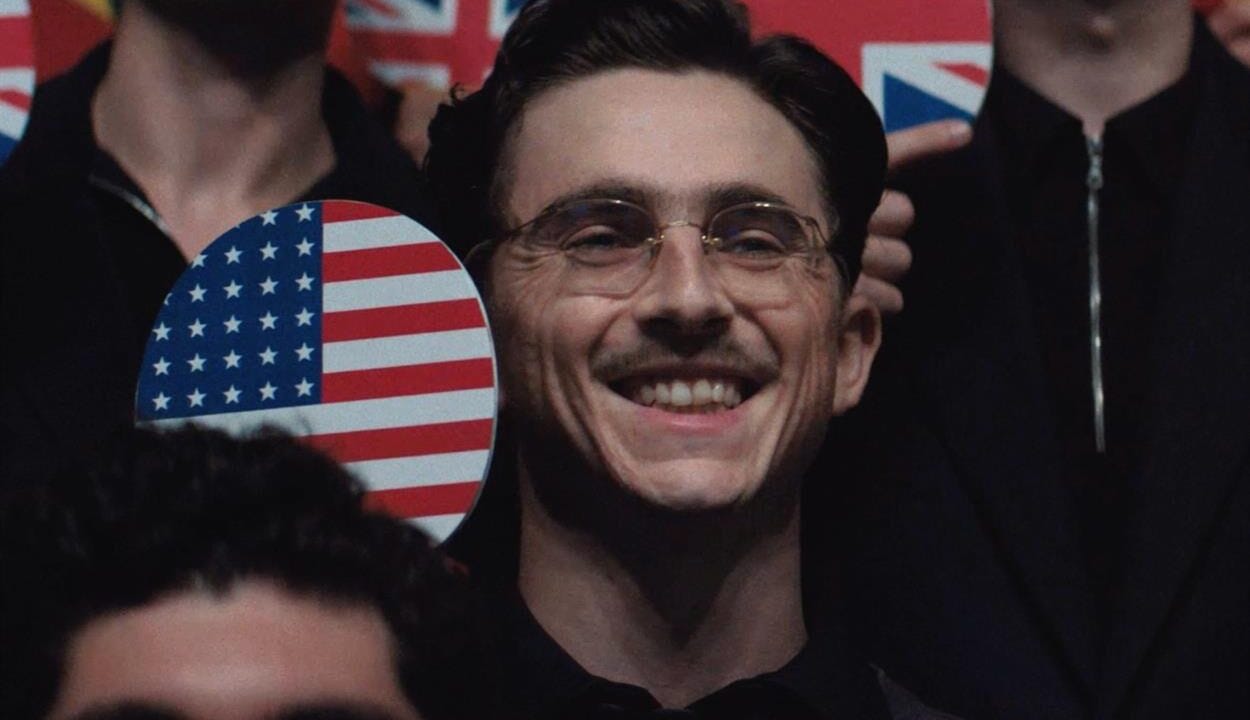
'Marty Supreme' Review: An Ode to Being Young, Dumb, and Full of Cum
New Timothée Chalamet film plays like The Brutalist meets Boogie Nights.
It blurs the line between Timothée Chalamet and Marty Mauser. The role was written for him, and it shows—in a way that’s both thrilling and faintly unsettling. The performance leans into Chalamet’s innate charm and confidence, even his worst impulses, and dares you to ask whether this clarifies the present Timmy press experience or further complicates it. Is he becoming the character, or is this all a bit? That tension—between sincerity and performance, self-belief and self-mythologizing—is exactly what makes the movie so alive.
Marty Supreme is an ecstatically realized portrait of mid-century America and of a man who believes himself destined for greatness. It’s hard not to recognize something deeply American in that conviction. This is a country that tells you, over and over again, that you deserve everything. I once had a history professor from Argentina who said, “There is no deserve in life. You deserve nothing.” Marty Supreme is built around that friction: American exceptionalism as both rocket fuel and moral rot. It’s what makes us both great and the most obnoxious assholes on earth.
Setting the film in 1952 is crucial. America had just “won” two World Wars, dropping two devastating atomic bombs, and an era of prosperity had begun. We’re feeling ourselves, and Marty is too. He’s from the tenements of Lower East Side NYC, sure—but he didn’t escape a concentration camp, nor did he fight in the wars that made this moment possible.
Compared to those who came before him—his fellow Jewish tribespeople lost to the Holocaust, or the Americans who died securing his freedom—he has it relatively made. His profound sense of self-importance and self-assuredness—both beautiful and maddening—are born out of this freedom. Nothing is more irritating than someone with actual talent who knows they’re the best—and Marty will be damned if he doesn’t get his God-given due.
That’s why the choice to make his antagonist Japanese is so smart. The postwar tension is obvious, but what really clicks is the contrast in values: a society predicated on humility, dignity, and honor facing off against Marty’s brashness, absurdity, and total lack of self-awareness.
We learn that his nemesis, Endo, lost his hearing due to the American firebombing of Tokyo. Marty, of course, doesn’t know this, nor would he care. One of the film’s most cutting moments comes after their final match. Marty yelps triumphantly to the stoic man, congratulating him on what a special moment this was (for Marty), failing to realize it falls on literal deaf ears. It’s a devastatingly wry bit of dramatic irony: American violence rendered invisible to the American who benefitted from it.
That same exceptionalism bleeds into Marty’s personal life. The ultimate schnorrer, he barrels through torrid affairs, walks over anyone in his path, and treats the people around him as expendable. And yet Chalamet is so likable and magnetic that it’s hard not to root for him anyway. Marty disrespects women, uses people, lies constantly, and is still kind of irresistible. That fascination feels depressingly familiar. We see it in celebrity and politics, where cruelty and narcissism aren’t just tolerated but perversely rewarded. We see it in sports, where extraordinary talent can excuse criminality. Brilliance blinds us. Marty Supreme understands that hypocrisy intimately.
This is where the film’s comps really start to click. Like The Brutalist, the movie is obsessed with the relationship between talent and patronage, between raw ability and old money. Kevin O’Leary’s character functions much like Guy Pearce’s in The Brutalist: the gatekeeper, the benefactor, and the embodiment of power that both enables and humiliates the artist. Marty, like Adrien Brody’s László Toth, is professionally undeniable yet personally exhausting—a pain in the ass whose gifts force the world to tolerate him, at least until the talent runs dry.
Marty is also a dead ringer for Boogie Nights’ Dirk Diggler: immature, brash, emotionally underdeveloped, yet blessed with a God-given gift that everyone around him keeps validating. Josh Safdie borrows that same discursive, side-quest energy in the plotting too. The movie is constantly wandering into adventures that technically advance the plot but mostly exist to deepen character and texture. One scene involving a dog-retrieval detour feels like a spiritual homage to visiting Alfred Molina’s cocaine den.
The film’s meaning and the exegesis of Timmy all would resonate far less if the filmmaking itself didn’t crackle the way it does. The movie is kinetic and alive, with Jack Fisk’s lived-in production design and Daniel Lopatin’s score doing enormous work. The music is twinkly and synthy, evoking the ’80s, but also austere and classical—creating a dialectical tension that propels the film forward even in its most stressful moments.
Gwyneth Paltrow is quietly brilliant here. This is the kind of role that often goes to someone like Nicole Kidman, but Paltrow brings a different, subtler energy. She’s sexy and melancholic, bored but perceptive, and crucially, she can read Marty like a book, knowing the score immediately. That he thinks he’s fooling her is just another expression of his delusion.
Ultimately, Marty Supreme is about all of this—American exceptionalism, postwar swagger, and talent as moral camouflage—but it’s also about something simpler and more primal: young men who are wildly underdeveloped yet convinced they hold the keys to the kingdom of life. Sometimes they actually do. More often, they’re just full of shit. Marty bluffs constantly, believes his own lies, and charges forward anyway. That might be the most accurate encapsulation of male youth imaginable.
The film both celebrates that kind of talent and indicts it. Chalamet gets to show just how great an actor he is, but the movie never lets him off the hook. It holds the ugliness and the success in the same frame, and in doing so, humanizes him. That balance is crystallized in the climactic scene, a pyrrhic victory. Not a world championship, not the pinnacle of the sport, just an exhibition match that no one will remember.
And yet, for Marty, it’s everything—a mountain climbed, a dragon slain. Unforgettable to him, even if the decades ahead will likely be more pedestrian. Marty Supreme understands the thrill of believing the world is yours—and the emptiness that follows when it turns out it never was.