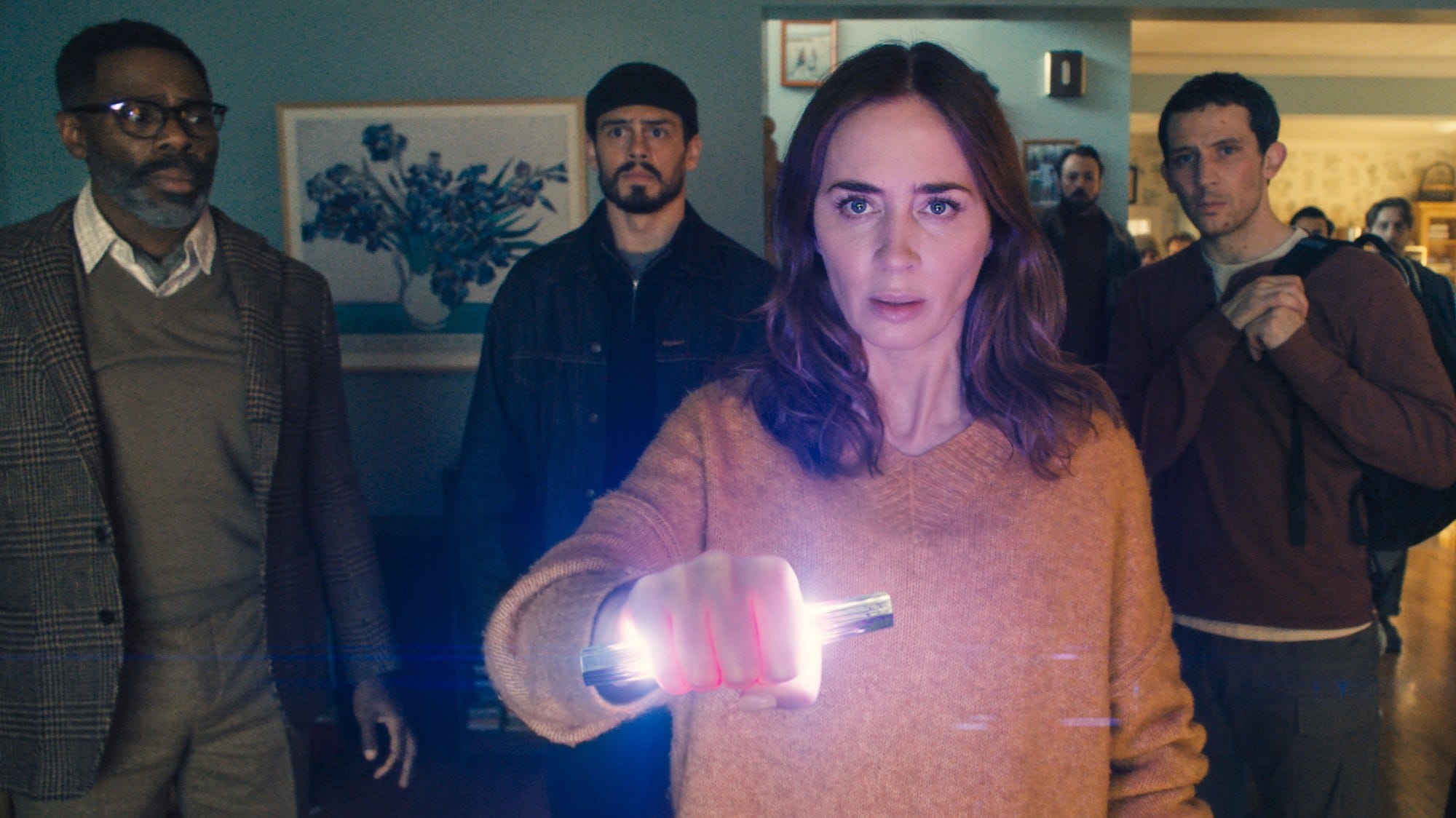
DISCLOSURE DAY Review
Latest Spielberg alien yarn entertains, yet hardly awes or provokes
There are filmmakers you admire, and then others you feel in your bloodstream and chemical makeup. Steven Spielberg is that for me. Nothing makes me cry more than E.T., thrills me more than Minority Report, or is as purely pleasurable as Jurassic Park—and that’s to say nothing of all else in between. So the fact that Spielberg’s new sci-fi film falls short of even my modest expectations is what makes Disclosure Day so hard to write about.
The concept is strong. It’s about two people who are drawn towards each other, perhaps through extraterrestrial means: Daniel Kellner (Josh O’Connor), who has just defected from WARDEX—the shadowy, government-adjacent service—and Margaret Fairchild (Emily Blunt), a Kansas City weather person.
WARDEX’s leader—Noah Scanlon, played by Colin Firth—is running a cover-up to conceal the coup, spearheaded by Colman Domingo’s Hugo Wakefield, who unfortunately does most of his acting on phone calls and amounts to no more than a less interesting version of Nathan Fielder in The Rehearsal.
The rift between Scanlon and Wakefield — the former about amassing power and sitting on secrets, the latter about exposing potentially world-altering ones — is a fascinating, diametrically opposed dynamic. But this is never taken further than the surface level. In general, the script falters: early on it’s very expository, and later it covers up its plot shortcomings with powers, usages, and MacGuffins that distract from a paucity of there there.
Frequently disappointing is the fact that WARDEX manages to nab both Kellner and Fairchild at various points, only to let them free in nonsensical ways. It makes this should-be-spooky company feel very defanged. There is one dark, genuinely innovative wrinkle — a strain of alien technology that lets Scanlon perform telepathy on unsuspecting people. Though we get no fleshing out of how it works, it’s visually striking, with a creepy horror-movie quality, imbuing its scene with immense tension. Aside from that, this company doesn’t feel dangerous and doesn’t kill anyone. Take instead the man with the keys in E.T. Though barely seen, he evokes a far more Gestapo-like fear than this bumbling ACME corporation.
O’Connor and Blunt are decent enough. The supporting cast is suspect. Wyatt Russell is Margaret’s boyfriend, Jackson, and his scenes are damn near unwatchable. Eve Hewson plays Jane Blankenship, a former novitiate and Kellner’s girlfriend, and it feels like her only functions are plot- and theme-related — a way to shoehorn, inelegantly, some ideas about faith into a movie that otherwise doesn’t have much thematic resonance.
Those, though, are small quibbles. A larger issue is the look of the film. Shot by Spielberg stalwart Janusz Kaminski, it’s got a gray, sludgy, shiny feeling, and I felt really taken out of the story because of it. Combine that with the anonymous Middle America setting—I hardly understood why this was set in Kansas City. Aside from perhaps appealing to flyover states, the location carries no political or thematic resonance.
Of the echoes of Spielberg’s previous work, perhaps the closest comp is E.T.: ordinary lives upended by something extraterrestrial, building to a large reckoning at the end. But that movie succeeds so brilliantly because it puts you in Elliot’s POV, which is wondrously awe-inspiring. It’s hard to invoke the same feelings watching grown adults play in a similar register.
In E.T. the grain, grit, and feeling of it lock you into the world. Here I never felt tethered to its reality. The CGI animals were abhorrent. Even in the film’s best set piece—a thrilling train-chase sequence—there is one shot amid it so clearly CG that it provoked a knee-jerk reaction. I even struggled to isolate and appreciate John Williams’ score.
I wonder what Spielberg’s “why now” was, what gripped him so. I suspect it’s tangled up in our shrinking attention spans and disconnection. Underneath it all there’s a plea for a type of mutual empathy and unification. It’s admirable to make that hope-core appeal, but I don’t think it meets the moment. I feel a lot more of that empathy and wonder in E.T., and right now, I think we’re all honestly closer to the nihilism of War of the Worlds—a much more dangerous, darker movie.
Disclosure Day is a strong yarn and an often fun diversion for two and a half hours—but it’s less than the sum of its parts. This isn’t Spielberg at his sharpest, his smartest, or his most entertaining. The ending semi-saves the movie, with a special kumbaya feeling to it, even if it maybe doesn’t square with the rest of the movie—a film that could’ve been better if it were funnier and better too if it were darker.
After The Fabelmans and now this, I’m not really sure what I want Steven Spielberg to do next. But I think it’s increasingly likely his best films are behind him. We’re in a good enough place, though, knowing he’s made so many perfect films to date.